This report analyzes the international shipping trends that defined 2025, when tariffs reshaped cross-border costs and compliance. Brands that were locked into a single carrier often faced painful choices: absorb margin hits, reprice overnight, or accept service disruptions. Brands with multi-carrier orchestration had a better option: keep shipping by dynamically rerouting and re-pricing while competitors scrambled to react.
ePost Global operates as a multi-carrier parcel consolidator, routing international shipments across a network of 100+ carrier partners spanning linehaul, airline, and final mile delivery. Because every parcel moves through our orchestration layer, we collect shipment-level performance data across carriers, destinations, shipping methods, and product categories at scale. The 23.3 million items analyzed in this report represent the full breadth of that network, not a sample. This gives the findings a depth and specificity that single-carrier studies or survey-based research cannot replicate: every data point reflects an actual shipment outcome.
Four capabilities, one X-factor
This report describes how four capabilities, when combined, created the X-factor that separated resilient logistics operations from vulnerable ones:
How multi-carrier shipping strategy absorbed the 2025 trade disruption
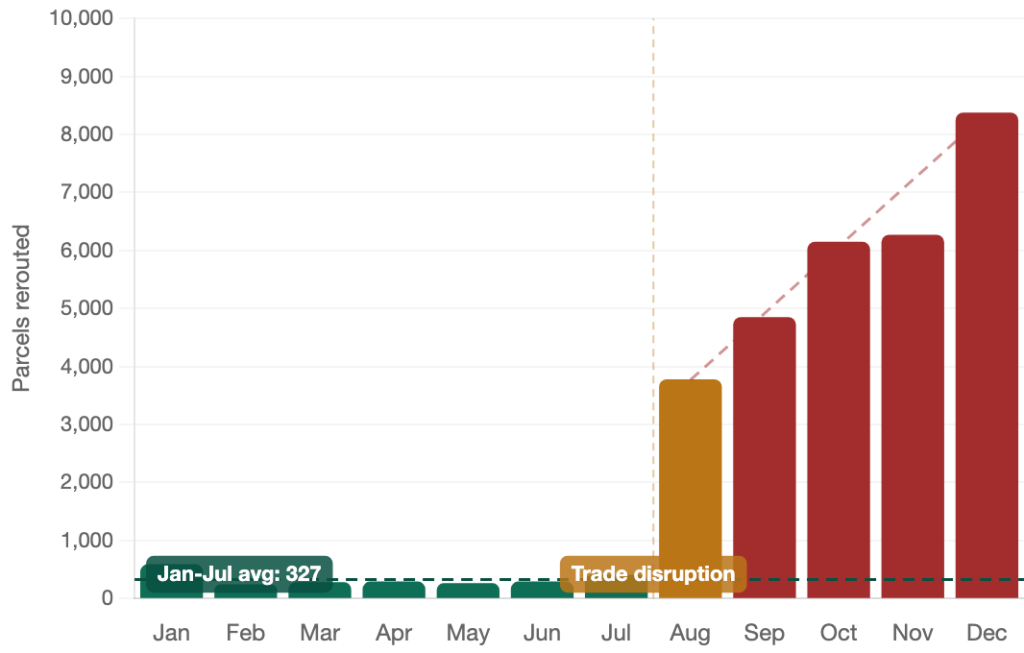
In August 2025, a trade disruption exposed the hidden cost of single-carrier dependency. Brands locked into volume commitments faced either breaching contracts or halting operations. Brands with diversified carrier networks rerouted shipments and continued servicing customers without disruption.
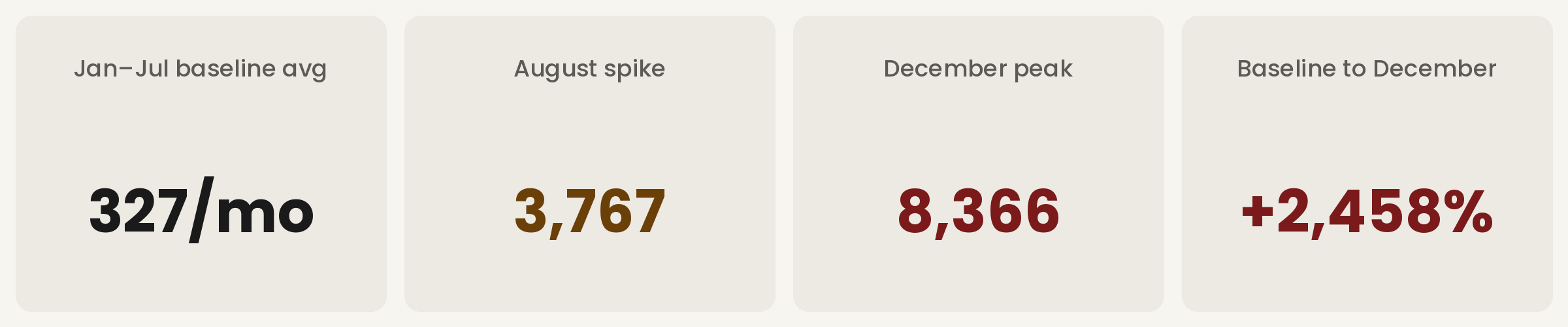
Rerouting needs surged from a baseline of roughly 300 parcels per month to over 3,700 in August alone, then continued accelerating through year-end, reaching 8,366 in December. That represents a 2,458% increase from baseline with no plateau in sight. Trade volatility used to be the exception: hurricane seasons, labor strikes, capacity crunches during peak periods. It has become the standard operating environment, and it is still intensifying.
Three factors drove continuous escalation rather than a return to baseline. Trade policy remained volatile through the second half of 2025. Carrier capacity stayed constrained. And customer expectations rose: brands that maintained delivery performance during the August disruption set a new service standard that customers now expect to be permanent.
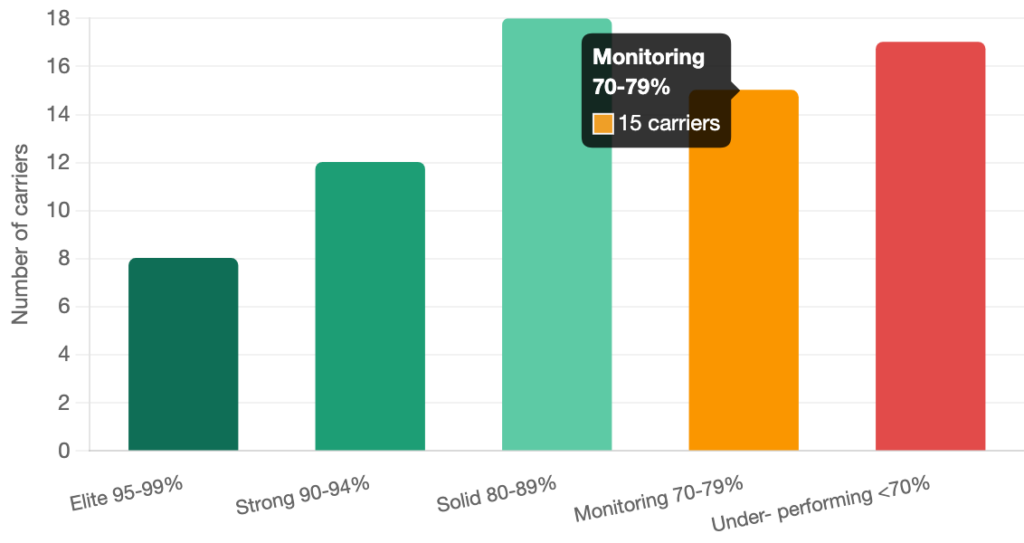
Exhibit 2: Performance variance poses existential risk when concentrated in a single carrier.
A multi-carrier network maximizes on-time delivery by concentrating volume among proven performers, shifting away from underperformers in real time, and maintaining the ability to reroute 30% of volume within 48 hours. Single-carrier models offer none of that flexibility until the contract expires.
Expert voice: Kelly Martinez, President
“Track on-time rates weekly, not monthly. Set automatic alerts when carriers drop below 85%. Performance erodes gradually. A carrier at 95% in January might hit 78% by December. Catch degradation early when you can shift volume gradually, not when you’re already in crisis mode.This monitoring gives you leverage in negotiations. Carriers know you’re tracking performance and have alternatives. That knowledge alone improves service quality.”
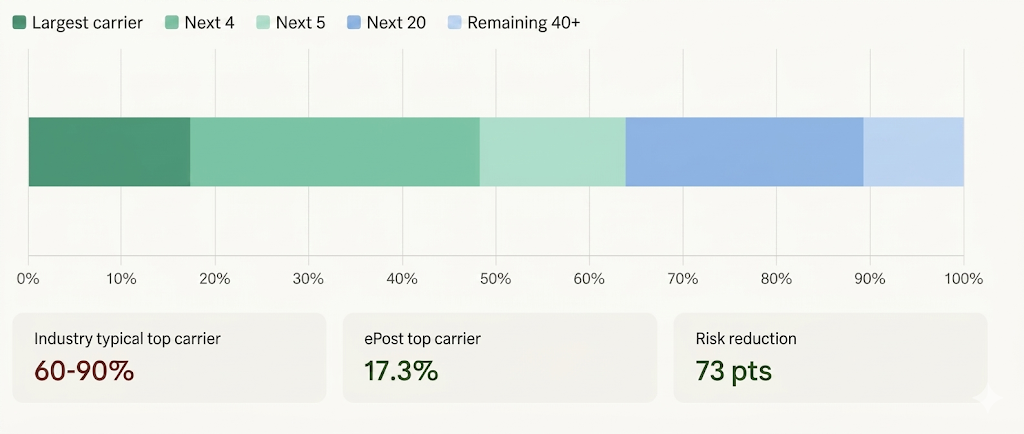
Exhibit 3: Concentration below 20% per carrier eliminates single-point-of-failure risk
The multi-carrier network is constructed to eliminate single-point-of-failure risk by preventing any carrier from becoming too dominant.
Expert voice: Fabrizio Alvear, Co-President
“Brands with automated routing shift volume in hours. Brands with manual processes take weeks. That time difference determines who maintains customer relationships. While systems take months to implement, relationships take time to establish. By the time you realize you need these capabilities, it’s too late. ePost’s infrastructure eliminates single points of failure.”
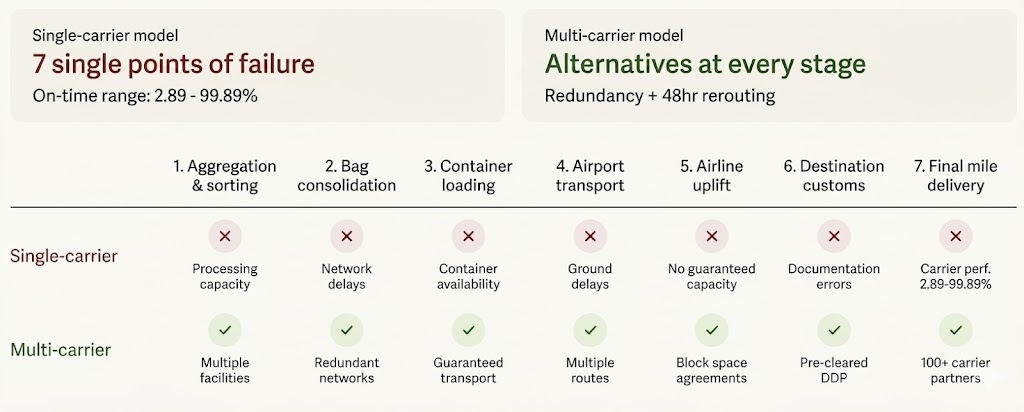
Exhibit 4: International shipping has seven failure points – resilience requires redundancy at all stages.
Block space agreements guarantee airline cargo capacity so you don’t compete for spot market space during disruptions. Airlines prioritize contract holders. Brands without this access wait in line.
Key findings
Volatility is structural, not cyclical: Rerouting increased over 2,400% from baseline to December, accelerating every month with no plateau
Performance variance is extreme: 96-point gap between elite (99.89%) and failure (2.89%)
Concentration creates existential risk: 17.3% max vs. industry typical 60-90%
Infrastructure timing matters: Build before crisis, not during
Business actions
Immediate (30 days)
Calculate concentration: Do your top carrier(s) exceed 50% of volume?
Map critical lanes by revenue impact (not just volume)
Monitor weekly performance with notification alerts set at 85%
Near-term (90 days)
Identify a multi-carrier solution for top 5 lanes (2-3 alternatives each)
Time your rerouting process: Can it shift 20% in 48 hours?
Eliminate single points of failure
Long-term (12 months)
Move toward 20% maximum concentration per carrier
Ensure your solution has block space agreements on airlines
Normalize volatility in budgets, training, planning
Resilience through diversification costs more than single-carrier optimization in stable periods. But because stable periods no longer exist, building flexibility now is the priority.
The pre-clearance advantage
DDP vs DDU: international shipping performance data
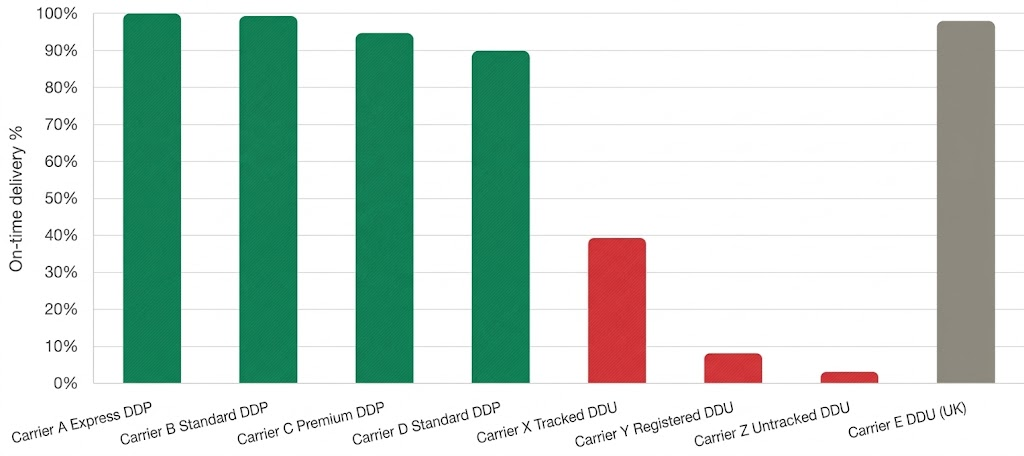
Parcels routed through perfect carriers are still at risk of failure if customs creates delays or checkout friction drives abandonment. The DDP (Delivered Duty Paid) versus DDU (Delivered Duty Unpaid) performance gap is wider than carrier variance: 99% versus 3% in worst cases.
The focus now is on customer experience and revenue retention. When customs delays disrupt expected delivery dates, the brand absorbs the reputational damage. DDP eliminates that risk by pre-clearing duties and documentation before the parcel ships. DDU shifts that burden to the customer at delivery, and the data shows customers overwhelmingly reject it. The cost difference between the two models is real, but the performance gap is larger.
Exhibit 5: Pre-clearance eliminates customs delays and surprise fees that cause DDU failures.
Pre-clearance via DDP effectively eliminates the customs delays and surprise fees that cause DDU failures. The performance advantage is dramatic and consistent across carriers.
Expert voice: Carlos Barbosa, VP of eCommerce Solutions
“DDP performs better because customs has no reason to hold the shipment. Revenue is already collected. Documentation is pre-verified. The parcel moves through clearance more quickly because no collection mechanism is required at delivery. With DDU, the carrier must collect payment from the recipient. Refused deliveries, return logistics, delays; every step introduces a failure point. Pre-clearance eliminates those failure points. But DDP doesn’t work everywhere. In markets with strong infrastructure, such as the UK, Canada, and Australia, DDP multiplies existing advantages. In markets where the fundamental problem is infrastructure, DDP won’t fix it. You might improve from 9% to 15% on-time, but you’re still failing most customers.”
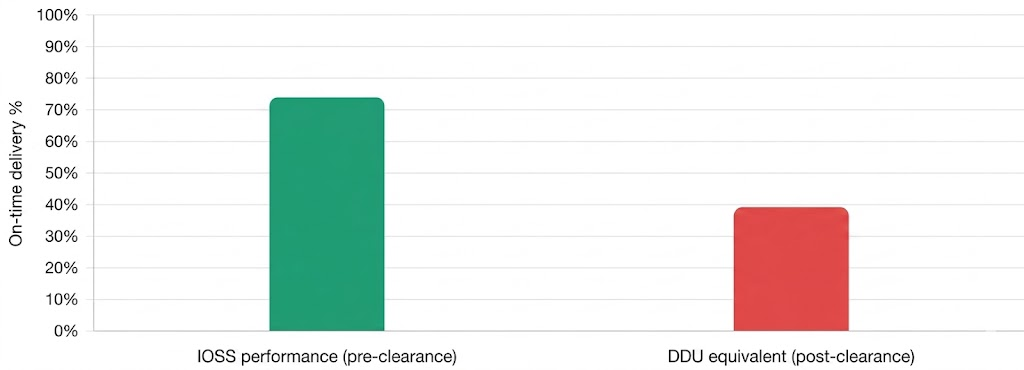
Exhibit 6: EU’s IOSS system shows where global customs is heading.
IOSS adoption grew as EU enforcement tightened
The EU's IOSS (Import One-Stop Shop) system simplifies VAT collection on imported goods. ePost shipped over 410,000 parcels through IOSS in 2025, showing 30-40 point improvements over traditional DDU. That performance gap is about to become a regulatory mandate.
By mid-2028, the EU is scrapping the current €150 IOSS cap and the customs duty de minimis exemption as part of broader VAT and customs reforms. IOSS will extend to all B2C imports regardless of value, meaning the low-value lane ePost has been optimizing now scales to a full catalog. VAT and customs duty will be due on every imported parcel, collected at the point of sale rather than at delivery.
For sellers, the implications are significant. IOSS becomes the default cross-border import rail: sellers and marketplaces that do not use it face multi-country VAT registrations and heavier customs friction. Full customs declarations become the norm for all consignments, increasing data requirements at order capture, including HS codes, accurate values, and IOSS IDs linked to each shipment. VAT and customs liability shifts upstream to the seller or facilitating platform rather than the carrier collecting at the door.
For customers, the shift is simpler: more tax-inclusive pricing at checkout, fewer surprise fees at delivery, and fewer parcels held at customs. But the end of de minimis also means even low-value items will carry duty, changing the economics of impulse purchases and pushing buyers toward larger, less frequent orders or EU-stocked inventory.
The 30-40 point IOSS performance uplift ePost demonstrated in 2025 was not just an optimization. It was an early move into the operating model the EU is codifying as the 2028 default. The same rails built for sub-€150 parcels will apply across the entire catalog once the cap is removed.
The DDP performance data also reveals which markets reward investment. Tier 1 markets like the UK (99% on-time), Canada (94%), and Australia (83%) have the infrastructure to amplify the advantages of DDP. Markets with weak postal infrastructure show marginal improvement even with DDP. Prioritize expansion based on performance data, not just market size.
Exhibit 7: DDP investment ROI – calculate on customer lifetime value, not per-order cost.
Businesses obsessing over their cost-per-order metric while ignoring LTV implications are optimizing short-term savings at the cost of long-term existence. Shift your top KPI to LTV-based ROI, and advanced pre-clearance and resilient networks become the only logical choice.
DDU is no longer a viable cross-border strategy: If your network relies on DDU, you are actively opting for a logistics journey with seven distinct single points of failure that collapse 60% of the time. This doesn’t just lose a sale; it destroys Customer Lifetime Value and threatens your brand reputation.
DDP is an investment, not just a cost: Spending $20 per order up-front on duties and pre-clearance should be viewed exactly like spending $20 on a successful customer acquisition or retention campaign. It guarantees delivery success (99%), buys customer trust, and secures $495 of future LTV. The return on investment is overwhelming.
Category complexity
Where specialized knowledge becomes competitive advantage
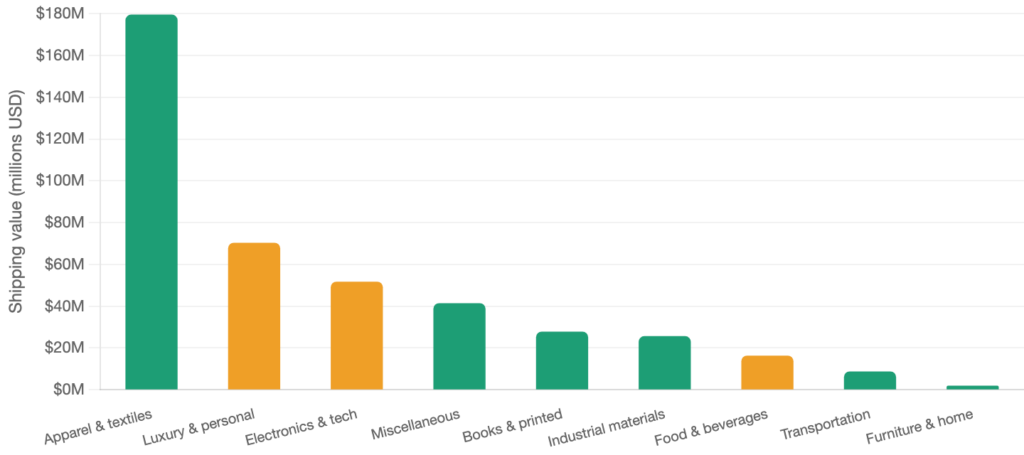
Electronics ($51.5M), food ($16.1M), and luxury goods ($70.1M) represent 32.7% of cross-border value but consume a disproportionate share of compliance resources. Collectively, these categories account for more than a third of broker fees, customs delays, and resources focused on compliance. The compliance cost per dollar of revenue is higher than in low-risk categories like apparel.
Brands that invest in dedicated compliance expertise turn high-risk categories into high-margin opportunities. Mastering complexity creates a barrier to entry: if your competitors cannot navigate the regulatory requirements for a given market, that market belongs to you.
Exhibit 8: One-third of shipping value requires specialized customs knowledge.
Expert voice: Alison Layfield, VP of Product Development
“Electronics face multiple regulatory layers. Lithium batteries have air transport restrictions that vary by carrier and country. Certain frequencies are banned in specific regions. Products overlapping with dual-use technology can trigger export control reviews.A product that ships fine to Europe might be restricted in the Middle East. A battery configuration acceptable on one carrier might be prohibited on another. You need country-specific and carrier-specific knowledge to navigate this successfully.”
Food and beverage: EU restrictions by product type
EU food restrictions are absolute. Know limitations before shipping, not after rejection.
Product type
EU status
Documentation required
Animal products (meat, dairy)
Near-total ban
Not shippable in most cases
Supplements
Restricted
Ingredient verification, IOSS may be required
Packaged foods (non-animal)
Permitted
Standard customs clearance
Beverages (non-alcoholic)
Permitted
Standard documentation
Alcohol
Restricted
Special permits, age verification
Example: Beef jerky approved for shipment to Australia but completely blocked for EU entry. No amount of documentation changes this; the product itself is prohibited. Certain countries prohibit foods from entering their borders due to biosecurity, health, or safety policies. Restricted goods are different: these items can enter if the required documentation is complete, including permits, health certificates, labeling, and quantity limits.
Navigating restrictions: a framework
Start with the correct HS code, then query destination-specific tariffs and restrictions through official customs portals or trade-restriction tools like Zonos. When rules are ambiguous, work with customs brokers who specialize in your product category. The goal is a structured, auditable process for every new market, not guesswork.
Expert voice: Alison Layfield, VP of Product Development
“Luxury goods like jewelry, perfumes, high-value cosmetics face scrutiny for two reasons: value thresholds and restricted materials. Perfumes with high alcohol content face flammability restrictions. Jewelry containing precious metals may require import permits and detailed composition documentation.The documentation must be precise. Vague descriptions don’t work. You need exact material composition, country of origin, accurate valuation, sometimes supporting documentation like gemological certificates. The more detailed your documentation, the smoother customs clearance.”
Automated systems vs. manual verification
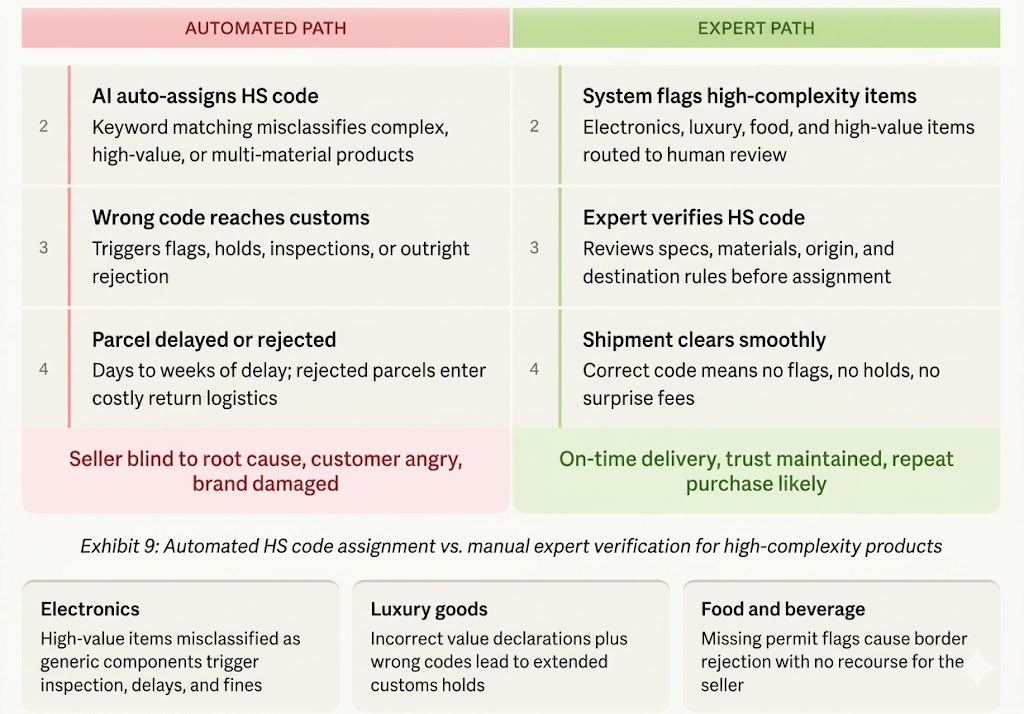
Many marketplaces use automated AI systems to assign HS codes based solely on keywords. This automation frequently assigns incorrect codes, leading to misclassification. The resulting chain reaction includes customs flags, delays, rejections, and reputational damage to sellers who have no visibility into the root cause. The impact is particularly severe for electronics, luxury goods, and food.
The fix: add human expert review for high-complexity or high-value products. Manual HS code verification ensures correct classification, smooth customs clearance, and successful transactions.
Expert voice: Alison Layfield, VP of Product Development
“For high-complexity or high-value items, verify HS codes manually. Don’t rely on automated systems. The cost of getting it wrong – delays, potential fines, damaged customer relationships – far exceeds the cost of proper classification upfront.Customs regulations constantly evolve. Enforcement priorities change. New restrictions get added. The brands that succeed long-term in complex categories treat regulatory compliance as ongoing discipline, not one-time learning.”
Category complexity creates barriers to entry that reduce competition. Brands that invest in specialized customs knowledge operate where generalist 3PLs cannot. But complexity requires genuine expertise, not assumptions.
Operational realities
2025 cross-border shipping data on returns, consolidation, and planning
This chapter addresses three operational realities that determine profitability: peak season return rates double baseline, consolidation delivers both cost savings and environmental impact, and 2026 planning must account for an accelerating disruption environment.
Peak season return rates: plan for 6%, not 3%
The peak holiday shopping season drives sales; it also drives returns. The volume of returns in Q4, and November specifically, is dramatically higher than the annual average, presenting a significant operational challenge for reverse logistics.
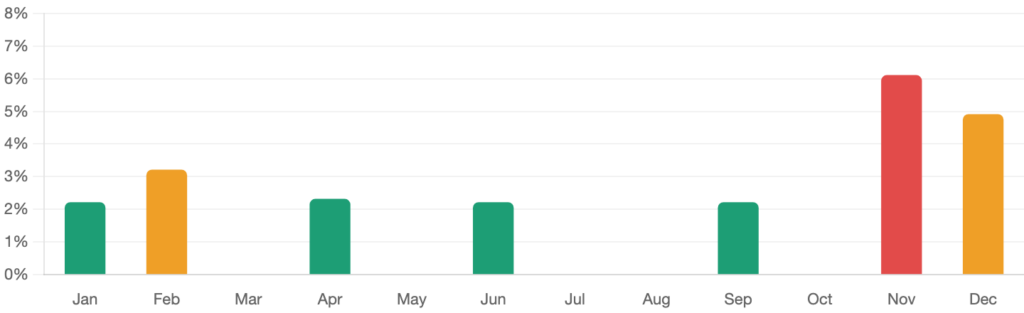
The data is clear: November’s return rate hit 6.1%, nearly double the 3.2% annual average. The Q4 average (November and December combined) held at 5.4%. Reverse logistics operations, from staffing to processing space to inspection capacity, must be scaled to handle double the baseline volume. Planning around the annual average guarantees you’ll be overwhelmed during the quarter that matters most.
Financial impact
If you process 100K November orders at $50 AOV with 6.1% returns, the costs add up: $305K in returned merchandise, $61K in reverse shipping ($10/return), $30.5K in restocking labor ($5/return), and $61K in markdown losses (20% of returns). Total return cost: $457.5K, or 9.2% of revenue.
Model Q4 P&L at 6% November returns and 5% December returns, not 3% annual average.
Environmental impact at scale
Across the 23.3M items shipped in 2025, multi-item consolidation reduced the total number of individual parcels entering carrier networks. If consolidation rates improved by 30%, the corresponding reduction in delivery vehicle miles, packaging materials, and urban congestion would be measurable at scale.
Every consolidated shipment reduces carbon emissions from transportation, packaging materials per item, and vehicle congestion in urban areas.
Its measurable environmental impact is tied directly to operational efficiency.
2026 strategic imperatives
1. Normalize volatility in planning
Budget for 10,000+ monthly reroutes based on December’s trajectory, not January’s 579 baseline
Train teams year-round on multi-carrier management
Run quarterly crisis simulations
2. Prioritize performance over market size
Invest marketing in Tier 1 markets (UK, Canada, Australia)
Avoid or limit exposure to markets with weak postal infrastructure (Brazil, Russia)
3. Implement DDP in top 3 markets
Canada (8.4M items, 94% baseline, room for improvement)
Australia (1.6M items, 83% baseline, +12 point potential)
UK (5.4M items, 99% baseline, maintain excellence)
4. Build category-specific expertise
Manual HS code verification for electronics, luxury, food
The 2025 data reveals that international shipping fundamentals have shifted permanently. Trade volatility is structural and accelerating. Performance variance is extreme. Infrastructure determines opportunity more than market size. Category complexity requires genuine expertise.
The brands that succeed in 2026 and beyond will treat resilience as equally important as efficiency, accept higher baseline costs in exchange for flexibility during disruption, and build capabilities before crises force them.
Methodology and data sources
This report analyzes proprietary shipment data from ePost Global’s network across the 2025 period. The dataset includes 23.3 million items shipped internationally across 200+ destination countries, utilizing 100+ carrier partners.
Analysis period
Primary: January 2025 through December 2025
Event focus: August 2025 trade disruption and subsequent escalation
Primary markets: North America, Europe, Asia-Pacific
Emerging markets: Latin America, Middle East, Africa
Analysis includes urban and remote delivery locations
Carrier network
100+ carrier partnerships across linehaul, airline, and final mile
70+ final mile carrier partnerships actively tracked for performance
Minimum 100-parcel sample size for carrier-specific metrics
Carriers anonymized in public reporting to protect commercial relationships
Product categories
Total shipping value analyzed: $421.3M across nine primary categories: apparel and textiles, luxury and personal items, electronics and technology, miscellaneous, books and printed materials, industrial materials, food and beverages, transportation, furniture and home.
Data aggregation
All data aggregated to protect individual customer confidentiality
Geographic performance based on delivered parcels (excludes undeliverable)
Return rates calculated from processed parcels vs. returned parcels
Carrier performance excludes routes with insufficient sample size
Limitations
Analysis reflects ePost Global network performance, not industry-wide
Carrier-specific data anonymized; trends shown in aggregate
Some markets have limited data volume (flagged in exhibits)
Performance metrics subject to external factors (weather, policy changes)
The ePost Global team of international shipping and logistics experts, dedicated to helping businesses of all sizes navigate cross-border ecommerce with smarter, more efficient delivery solutions.
Let's take your business global
Connect with our sales team and scale your reach to new markets.
We write about the things that actually affect your bottom line — carrier strikes, duty changes, platform risk and how to build a shipping stack that doesn't break.