With the right global eCommerce growth strategy, it's never been easier for an online store to reach new customers and drive more eCommerce sales. Online marketplaces and social media creators can unlock traffic from new countries in a single campaign, flooding your online store with potential customers and driving traffic you wouldn’t reach through domestic marketing campaigns alone.
But once an order is placed, it’s just as easy for eCommerce brands and platforms to get global expansion wrong. Everything from the shipping infrastructure behind the scenes to the post-purchase experience can spoil a brand’s opportunity to grow overseas and keep customers coming back.
This guide focuses on the operational side of global eCommerce growth strategy—the stability layer between demand and delivery. That’s where ePost Global operates, helping brands, platforms, and marketplaces whose international volume is no longer experimental avoid shipping surprises that erode margins and trust. Global growth doesn’t usually fail in marketing; it fails quietly after checkout, when delivery and duties don’t match expectations. If your international revenue is growing faster than your shipping confidence, this guide is for you.
Growth is no longer the hard part
As any global eCommerce growth strategy matures, many teams realize that access to customers is not the same as the ability to serve them. When shipping promises and delivery performance fall out of sync, conversion rates and customer lifetime value can start to slide, even while top-of-funnel metrics look strong, customer engagement appears healthy, and marketing campaigns continue to perform.
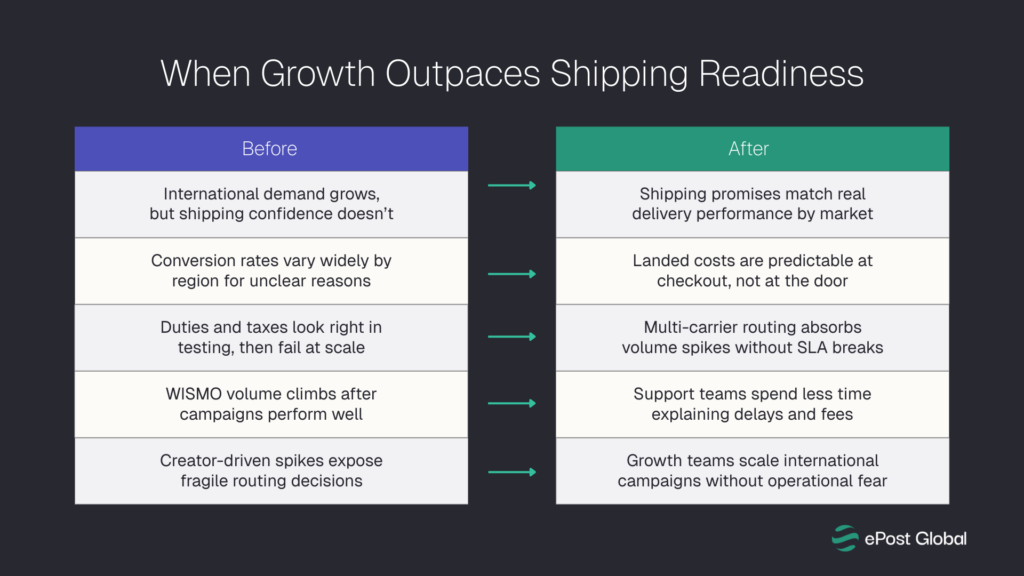
It’s not uncommon for eCommerce businesses to think they have a demand problem when they actually have fragile logistics systems that weren’t built for international complexity or creator-driven spikes in orders, making it harder to optimize for repeat purchases and long-term customer retention. Shipping is often one of the largest cost of goods sold (COGS) line items. When transportation and duties fluctuate, they can quickly blow up pricing models and the key performance indicators (KPIs) leadership cares about.
Today's winning eCommerce growth strategy treats logistics and post-purchase operations as core levers. That means looking beyond customer acquisition cost (CAC) and return on ad spend (ROAS) and paying close attention to items such as “where is my order?” (WISMO) customer service volume and regional conversion rates as signals that determine whether global growth is durable or fragile, and whether you’re building loyal customers or burning through new customers you just paid to acquire.
The false promise of easy international expansion
On most eCommerce platforms, global expansion looks like a simple change of settings. All you need to do is turn the cross-border shipping light on, plug in a few carriers or apps, and suddenly your eCommerce site can accept orders from dozens of new countries with almost no additional effort. In fact, many plugins promise frictionless international growth for brands on Shopify and similar platforms.
That story may hold for a while, but only until volume exposes the gaps. When brands ship DDU or rely on rough guesses for duties and taxes instead of a true landed‑cost model, customers are hit with surprise charges at the door, leading to cart abandonment and refused deliveries. The customer experience takes the hit long before anyone traces it back to how duties were set up in the first place.
Routing is usually just as brittle. Many international setups that claim to be easy lean only on one or two carriers per corridor, meaning a single service disruption can trigger missed delivery promises. For businesses, what felt fine when 5% of revenue was international becomes unsustainable when that mix approaches 20%–30% and your support teams were never built for that level of cross-border activity.
Even the checkout process can quietly stifle growth. When shoppers find international checkout confusing, with inconsistent duties or vague delivery windows, they’re more likely to abandon their shopping cart because the shipping experience feels risky… which it is.
Businesses have to accept that you can’t just turn on international shipping. It’s not a global eCommerce growth strategy in and of itself, but rather a bridge to growth—one that’s shaky if it lacks a well-established foundation.
Three constraints that quietly kill global growth
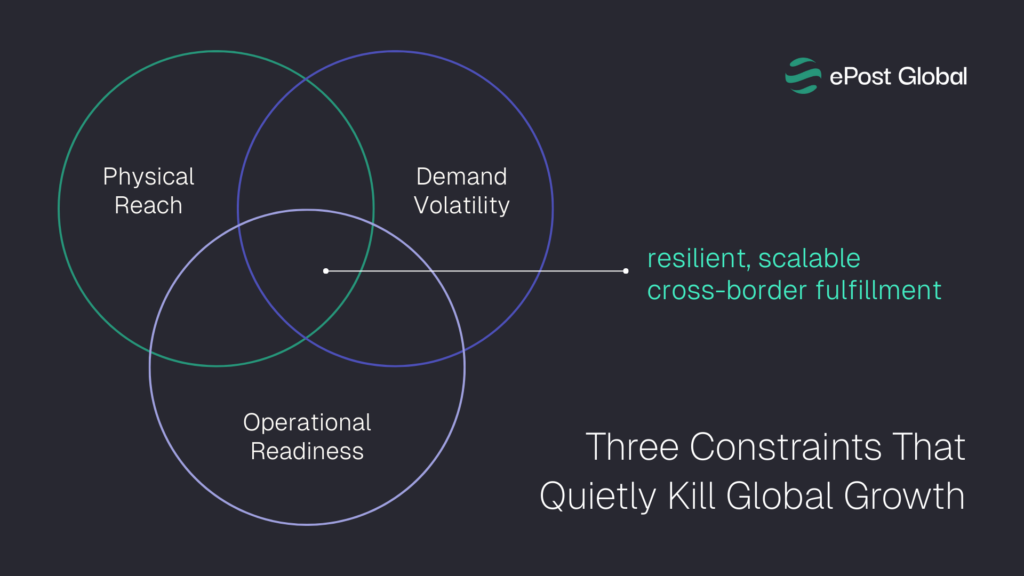
In our experience, three underlying factors determine whether international revenue compounds or stalls.
Physical reach
The first constraint is physical reach, meaning how many lanes you can serve reliably, at acceptable transit times and cost. Many brands and platforms rely on one or two carriers for most, if not all, of their international volume. This covers the basics but doesn’t provide the lane diversity needed for real resilience. Limited coverage leaves whole pockets of potential customers underserved or unserved, dragging down conversion rates and average order value in regions like the United Kingdom, the European Union, Canada, and Australia where marketing is active but shipping promises and duties remain unpredictable.
Operational readiness
The second constraint is operational readiness: whether systems, processes, and people can handle cross-border fulfillment at scale. When routing or delivered duty paid (DDP) calculations aren't automated, manual workarounds start to crack under pressure, typically showing up after the purchase as an increase in WISMO tickets or slow responses to delivery issues. This overwhelms support teams and erodes customer loyalty while pushing customer acquisition costs higher to replace churned buyers.
Demand volatility
The third constraint is demand volatility, especially from social media platforms such as TikTok. Many modern eCommerce growth strategies lean into influencers and omnichannel campaigns that can generate thousands of orders in hours. If the logistics network can’t absorb those spikes, the content creators notice when their audiences complain, and their next campaign will likely go to a competitor whose infrastructure can actually hold the service level agreements (SLAs) they promise.
Democratizing global commerce
Robust cross-border capabilities have historically belonged to enterprise retailers with the volume, leverage, and in-house expertise to negotiate global contracts. A modern global eCommerce growth strategy needs to close that gap.
Fast-growing eCommerce brands now need that same level of operational predictability. However, they don’t want to hand over customer data or their brand narrative to a third party that will own the full customer journey; they want enterprise-grade infrastructure with the independence and flexibility of a DTC brand.
Democratizing global commerce means letting more eCommerce businesses operate globally without requiring a logistics PhD on staff. Businesses need access to intelligent routing and compliance support so that their teams can focus on growth without surrendering control of their brand or their economics.
Why judgment impacts AI recommendations
There's no shortage of software dashboards and algorithms promising to power a global eCommerce growth strategy. Of course, AI-powered recommendations and dynamic pricing are powerful, all-but-essential tools, especially when they use real-time data to do things like sharpen product recommendations and push upselling across channels.
But the world your parcels move through doesn’t behave like a clean dataset. Many global occurrences, such as carrier strikes and sudden geopolitical events, don’t line up neatly with last quarter’s patterns. And when conditions flip overnight, purely algorithmic routing and duty calculations can make the wrong call at scale, leaving brands exposed.
Judgment is crucial here. That’s why ePost Global combines real-time multi-carrier intelligence with teams who have decades of international logistics experience per person—people who know when a good-on-paper route is about to turn into a support nightmare. These experts adjust their choices as the situation evolves, using data as input rather than fixed factors.
That blend of automation and human judgment shows up in the gaps that usually hurt the most. It turns surprise fees, previously a source of abandoned carts, into a transparent part of the checkout experience and prevents “where is my order?” noise from overwhelming support. It gives brands a growth engine that can absorb volatility without undermining the post-purchase experience customers remember.
A global eCommerce growth strategy
Global eCommerce growth often stalls when shipping operations aren’t built for the realities of cross-border volume.
Lane expansion into new markets
Many eCommerce brands and logistics platforms know where demand is building but can’t confidently deliver into those regions with their current carrier mix. ePost Global’s international lane expansion lets them plug into coverage across more than 200 countries and territories without stitching together fragile, one-off carrier relationships.
That reach makes it safe to localize marketing and tailor messaging by region because shipping promises are backed by a resilient network and real-time performance monitoring.
Fixing post-border failure
Post-border failure is everything that goes wrong after a parcel leaves the origin country but before the customer feels the order is complete. This can be anything from surprise duties to disjointed return processes. Those moments quietly drain conversion rates, even when the product and marketing are doing their job.
ePost Global’s returns support shrinks these failure points by tightening DDP accuracy and handling exceptions in real time. When customers know exactly what they’ll pay at checkout and what happens if something goes wrong, they’re more likely to complete the order and far more open to coming back, giving brands room to test pricing without fearing that landed-cost models will blow up in the background.
Balancing cost with service
Shipping often becomes the largest cost driver as international volume increases, and most teams end up choosing between expensive integrators that protect SLAs and cheaper carriers that create delivery failures.
Using multi-carrier orchestration to balance cost against real delivery performance, ePost Global’s Mail and Domestic/Canada Edge options are built to keep unit economics in line on those high-volume corridors without letting reliability slip. When costs and service levels are predictable, finance and marketing teams can plan CAC and lifetime value with more confidence and run bolder plays—such as bundling, upselling, and new product launches—without worrying that a bad month of carrier performance will erase the upside.
Stabilizing creator-driven DTC growth
When TikTok trends and user-generated content push a brand into the spotlight, orders can spike overnight. However, if the logistics network can’t absorb that surge, the backlash can be immediate, very public, and very damaging to the brand.
ePost Global’s Brand DTC support is built to take those hits without letting the post-purchase experience crack. We use multi-carrier routing, real-time performance monitoring, and experienced exception management to help brands hold their SLAs even when social traffic floods the store, giving them room to run bolder campaigns and test new products.
Turning shipping into a growth lever
Global growth often plateaus in the parts of the journey that are supposed to feel routine, whether that’s when duties are calculated or when a carrier misses a handoff. How brands handle these moments determines whether they lose international revenue or transform shipping into a reason loyal customers come back and leave stronger customer reviews that increase sales.
Winning businesses track metrics such as first-scan-to-delivery time and post-purchase satisfaction with the same rigor as they do clicks and conversions, because those numbers tie directly to repeat purchases and long-term eCommerce success. They then invest in infrastructure and partners that keep their brand front and center while absorbing volatility underneath. They manage to be predictable even when the world isn’t.
ePost is built to be the stability layer that turns shipping from a risk into a global eCommerce growth strategy that compounds. With intelligent multi-carrier orchestration, an average of 30 years of expertise per employee, and real-time performance monitoring, our systems and people work together so that brands can expand internationally without giving up control of their customer data, while deepening partnerships with the teams responsible for growth.
If your brand is adding new markets, you can use one simple test to find out if you’re truly ready: Would you be comfortable if your biggest creator pushed global traffic tomorrow? If the answer is “not yet,” shipping is still a risk to manage instead of a lever you can pull.
If you want to know whether your current shipping setup would survive a creator-driven global spike, that’s a conversation worth having. Talk to a logistics strategist today.
Global eCommerce growth strategy FAQs
Cross-border shipping shapes who you can reliably sell to and how much they trust you after the first order. When delivery times and duties feel predictable, your customer base grows in new markets and brand loyalty improves because customers feel safe buying again.
Where does eCommerce marketing fit with all this?
eCommerce marketing drives attention, but logistics helps decide whether that attention becomes repeat revenue. The strongest eCommerce growth strategy connects both sides so your messaging matches real-world performance. Campaigns work best when they’re aligned with what your shipping network can consistently deliver, so your messaging matches real-world performance.
What shipping functionality matters most in a global eCommerce growth strategy?
Focus on functionality that protects the customer experience at scale. This can include accurate DDP, multi-carrier routing, reliable tracking, and clear returns flows. These capabilities reduce friction for both customers and support teams.
How does my target audience shape a global eCommerce growth strategy?
Different demographics expect different speeds and price points. For example, younger, creator-led audiences may tolerate slower shipping if fees are transparent, while certain regions expect faster delivery. Your shipping setup needs to reflect the expectations of each target audience you’re investing marketing dollars in.
What does a data-driven shipping strategy look like?
A data-driven approach uses concrete key performance indicators, such as WISMO per 1,000 orders, SLA adherence, first-scan-to-delivery time, and regional conversion, to decide when to change carriers or routes. It’s essential to use real numbers to fine-tune everything from lanes to post-purchase communication.
What retention strategies depend on strong cross-border delivery?
Loyalty programs and referral campaigns work only when customers trust that repeat orders will arrive as promised. With stable cross-border delivery, you can turn retention strategies from risky experiments into dependable growth loops that extend the lifetime of each customer relationship and increase sales from repeat purchases and loyal customers.
Why does high-quality shipping matter if my products are strong?
High-quality products can’t compensate for poor delivery experiences. When shipments arrive late, with surprise fees or confusing returns flows, customers often blame the brand, not the carrier. This makes them less likely to recommend or repurchase, even if they loved the product itself.
How should marketing efforts adapt when shipping becomes more predictable?
Once shipping is predictable, marketing efforts can get bolder, including region-specific campaigns, influencer marketing and creator collaborations that include international audiences. These kinds of marketing campaigns work best when the user experience supports stronger customer engagement and better customer reviews.
What does a global eCommerce growth strategy look like?
A global eCommerce growth strategy goes beyond marketing and customer acquisition. It includes the operational infrastructure needed to deliver on the promises your campaigns make, from multi-carrier routing and accurate landed-cost calculations to reliable last-mile delivery and transparent post-purchase communication. When logistics keeps pace with demand, international revenue compounds instead of stalling.
How do I build a global eCommerce growth strategy that scales?
Start by auditing your shipping network for single points of failure. If you're relying on one or two carriers for most international volume, a single disruption can break your delivery promises. A scalable strategy pairs lane diversity with automated DDP calculations and real-time performance monitoring so your operations can absorb demand spikes without cracking.